
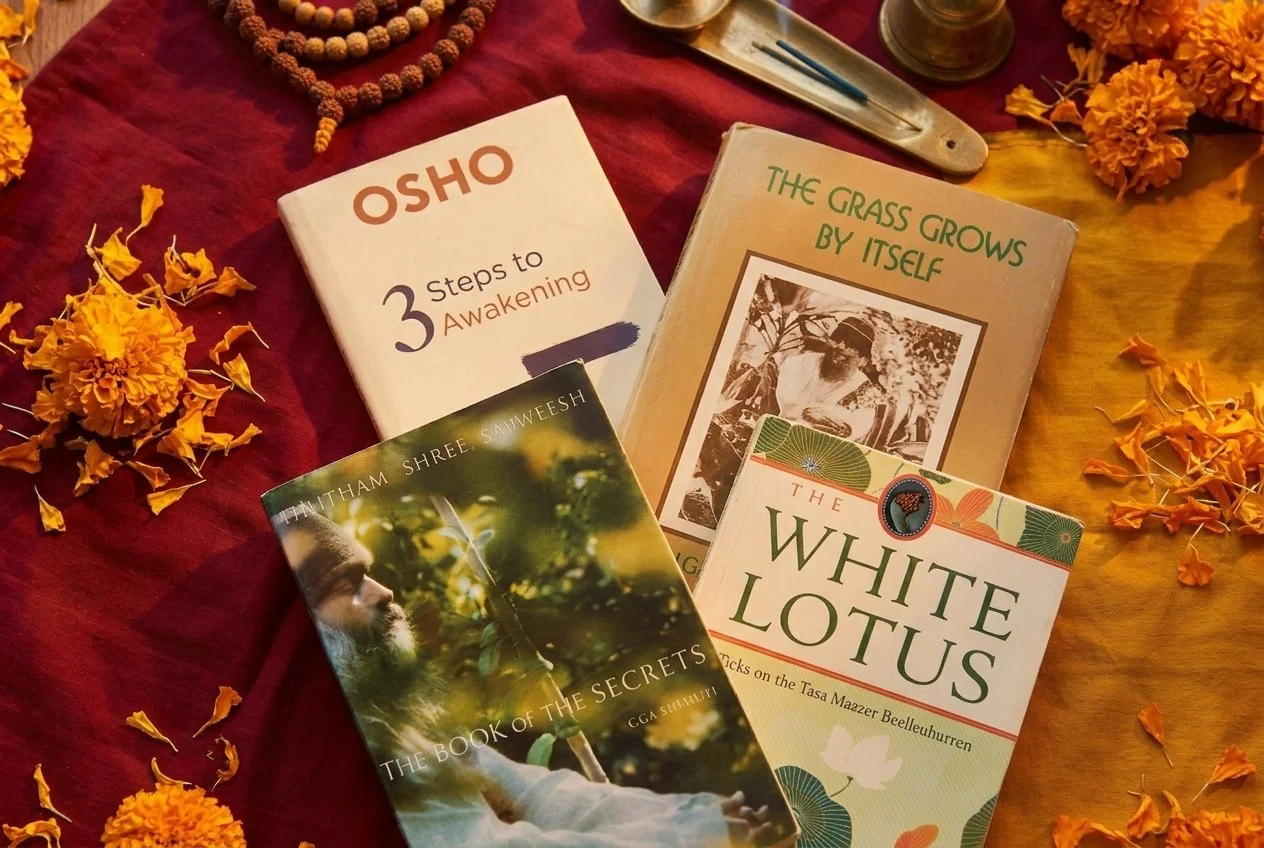
The older books on this shelf read Bhagwan Shree Rajneesh on the spine. The newer ones say Osho. Same teacher, but he took the name Osho in 1989, so the spine tells you roughly when a copy was printed. Among them is a 1976 first edition of The Book of the Secrets, Volume 3, published by the Rajneesh Foundation in Poona more than a decade before he took the name Osho. We're a small Australian shop selling secondhand spiritual books, and every book here is a single copy.
The Rajneesh and Osho books
Most of the books began as talks. His followers transcribed and edited them, which is why they tell jokes and answer questions from the floor.
The Book of the Secrets is his commentary on the Vigyan Bhairav Tantra, a short Kashmiri text in which the goddess Devi asks Shiva about the nature of reality. Shiva answers with 112 ways to meditate, and Rajneesh works through them one talk at a time. We have one copy: Volume 3, a 1976 first edition, published under the Bhagwan Shree Rajneesh name.
The Grass Grows by Itself collects his Zen talks, first published by the Rajneesh Foundation in 1976. A disciple asks what keeps him anchored, and he answers with a joke about four clergymen confessing their vices. The rabbi likes pork, the minister drinks bourbon, the priest has a girlfriend, and the Baptist likes to gossip. That, says Rajneesh, is his answer too. The talks are gossip.
The White Lotus is his talks on Bodhidharma, the monk said to have carried Zen from India to China. Ours is the Jaico edition.
My Way: The Way of the White Clouds takes a white cloud as the picture of a seeker, going nowhere in particular and putting up no resistance. Check the title page for the edition and year. "The journey is the goal," says the blurb.
3 Steps to Awakening is the short one, and the newest book here: a 2018 English translation of talks Osho gave in Hindi in 1965 at a meditation camp in Rajasthan. His three steps are freedom of consciousness, simplicity of mind and emptiness of mind.
About the man
In 1981 Rajneesh and his followers bought a large ranch in Oregon and built a commune, Rajneeshpuram, which grew to about 7,000 people in two years. Its leaders went on to commit a string of crimes, including arson, wiretapping and attempted murder. The worst was the 1984 contamination of salad bars in The Dalles with salmonella, planned by Ma Anand Sheela and the nurse practitioner Ma Anand Puja to keep voters home on election day. 751 people fell ill and 45 went to hospital. Nobody died. Sheela and several of her lieutenants were convicted. Rajneesh was never prosecuted for the attack. After Sheela and other leaders left in September 1985, he denounced her publicly, fled Oregon on chartered jets and was arrested in North Carolina on 28 October. He pleaded guilty to two immigration counts and agreed to leave the country.
Tantra
In the West, tantra has come to mean sex. The older traditions are South Asian systems of ritual and philosophy built around mantra, initiation, visualisation and meditation, and sexual practice appears in some of them and not in others.
David Deida's Finding God Through Sex sits at the modern, Western end, with a foreword by Ken Wilber. Women of the Light, edited by Kenneth Ray Stubbs, is subtitled The New Sacred Prostitute, and it means it. The women who wrote it include a porn star, a sex surrogate and a call girl, each describing her work in her own words.
For the older landscape, Alex Wayman's The Buddhist Tantras is the academic one. David Frawley's Inner Tantric Yoga is for practice, and its subtitle sets out what it covers: mantras, deities and meditation.
Kundalini
Yoga describes kundalini as an energy lying coiled at the base of the spine. The standard English text on it came from an unlikely author. The Serpent Power appeared in 1919 under the name Arthur Avalon. Behind the name was Sir John Woodroffe, a judge of the High Court in Calcutta, who translated Sanskrit tantric texts on the side. Ours is the 1974 paperback.
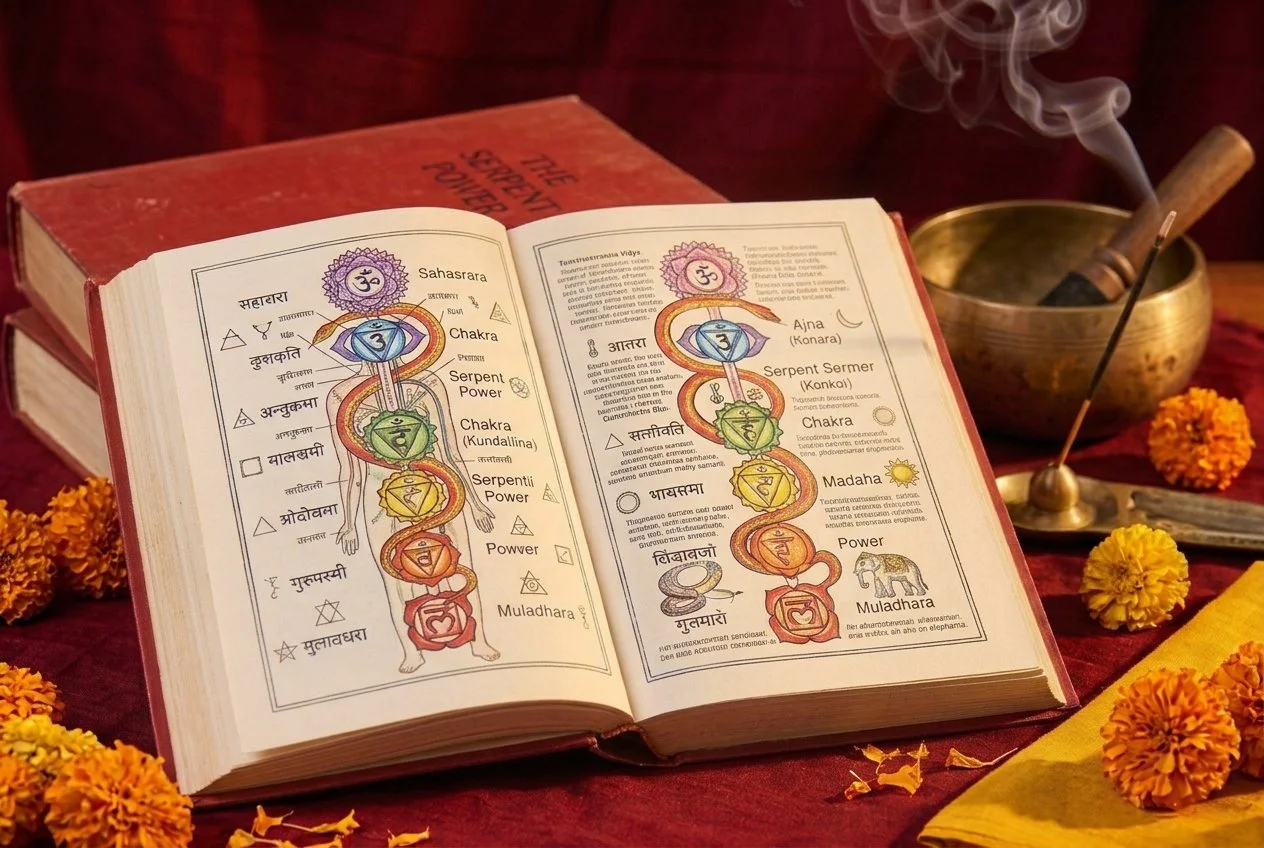
Lee Sannella's The Kundalini Experience asks a doctor's question. Sannella was a medical doctor, and he looked at what people go through when they believe kundalini has woken in them, and how that differs from mental illness. The 1987 Integral Publishing paperback. For the practice itself there's Kundalini Yoga by Swami Sivananda.
Afterwards
Jack Kornfield's After the Ecstasy, the Laundry is about what happens when the retreat ends and the dishes are still there. Kornfield draws on Buddhist, Christian, Jewish, Hindu and Sufi traditions and follows the big experience into work, illness, loss and death.
You'll find this shelf in our Eastern Philosophy category, where each book is listed as a single copy.
Please note: the images in this post have been stylised with AI and may not match the exact copy. Covers and editions may differ. See each book's product page for an unedited photo of the copy you'll receive.